

Oscars Best Picture Nominee Patterns

BEST PICTURE MATERIAL

It’s the most prestigious award in the Oscars: Best Picture.
Looking at the nominees over the past decade, patterns emerge. A film that premieres at the Venice Film Festival is almost 50% more likely to produce a Best Picture nominee than Cannes. And winning TIFF gives you a 90% chance of nabbing a best picture nomination. And if your film is nominated, it likely falls into one of the following genres: Drama, Dramedy, Historical, Biopic, or Coming-of-Age film.
Read on for a breakdown of the DNA of Best Picture Nominees.
The data: the statistics below, unless specified, relates to recent Oscars history. This ranges from the 88th (2016) Academy Awards to the 97th (2025).
FESTIVALS
Hype is an ever-growing currency. A modern film’s success is determined less and less by word-of-mouth after theatrical release and more by the marketing efforts leading up to it. This is where film festivals come in.
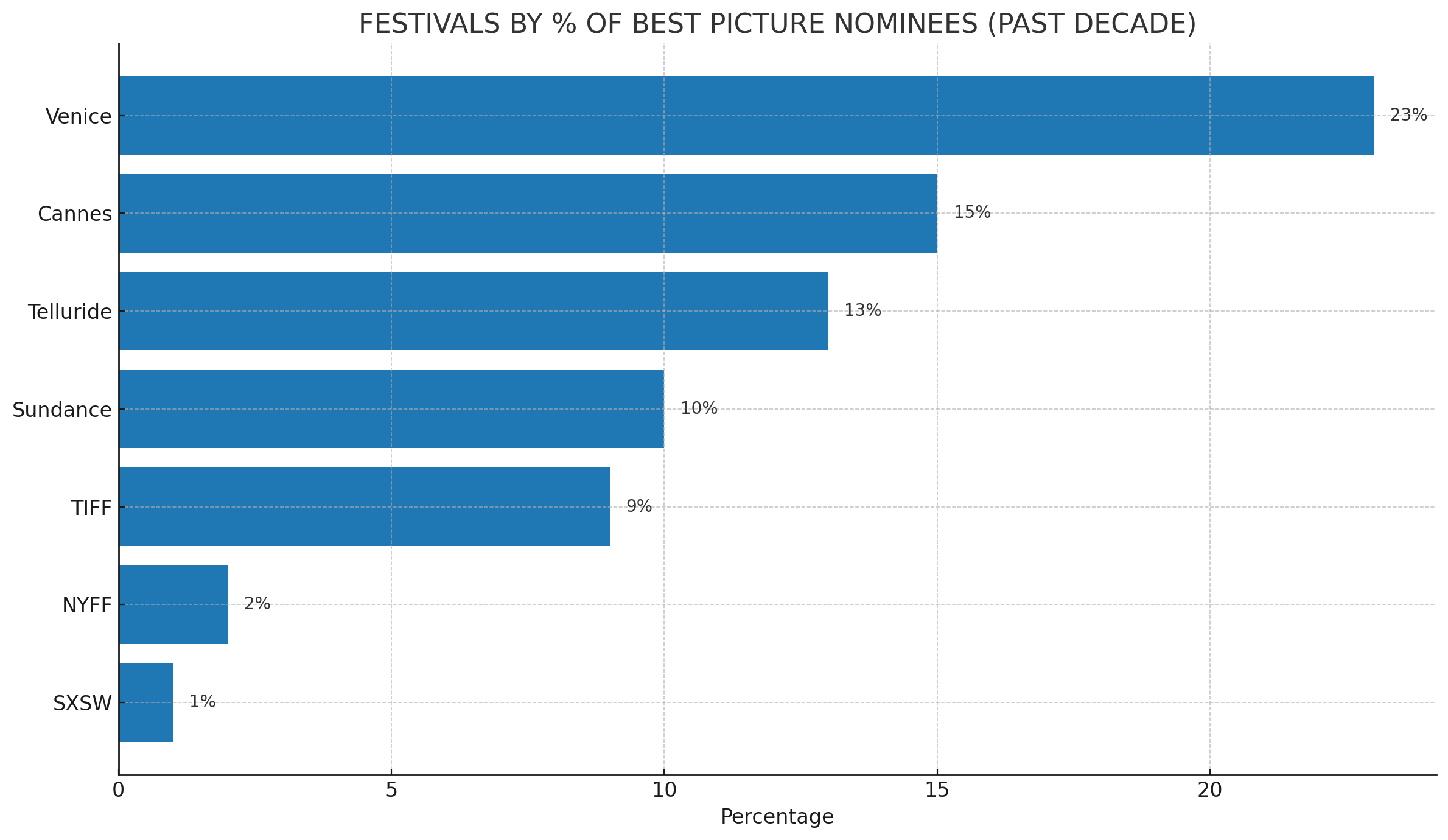
Though film festivals have always been important in showcasing the best of cinema, there’s now a direct pipeline to the Oscars. In the last ten years, 74% of Best Picture nominees premiered at a prestigious festival. That’s a 21% increase on the ten years prior.
Festivals by the percentage of Best Picture nominees over the past decade:
Venice - 23%
Cannes - 15%
Telluride - 13%
Sundance - 10% (boosted by the pandemic when Cannes was canceled)
TIFF - 9%
New York - 2%
SXSW - 1%
The clear taste-maker is Venice, and this is for a few reasons. It is the perfect mix of international and commercial. Studios like Warner Bros., Netflix, Amazon, and Searchlight enjoy working with the festival, not just for the flashy red-carpet press opportunities. They also value its late August/early September dates, which align perfectly with the timing to launch an Oscars campaign. Although in the case of Joker 2, we’ve seen this backfire.
Cannes’ official selection, by contrast, is skewed towards arthouse. And they’ve got a rocky relationship with distributors, like Netflix, which was banned in 2018.
92% of Best Picture nominees are in English, so it might seem that Venice is getting a bit of a bump. But surprisingly, Venice and Cannes are almost even when it comes to the percentage of official selections over the last ten years that are English-language. Cannes is 32% and Venice is 30%.
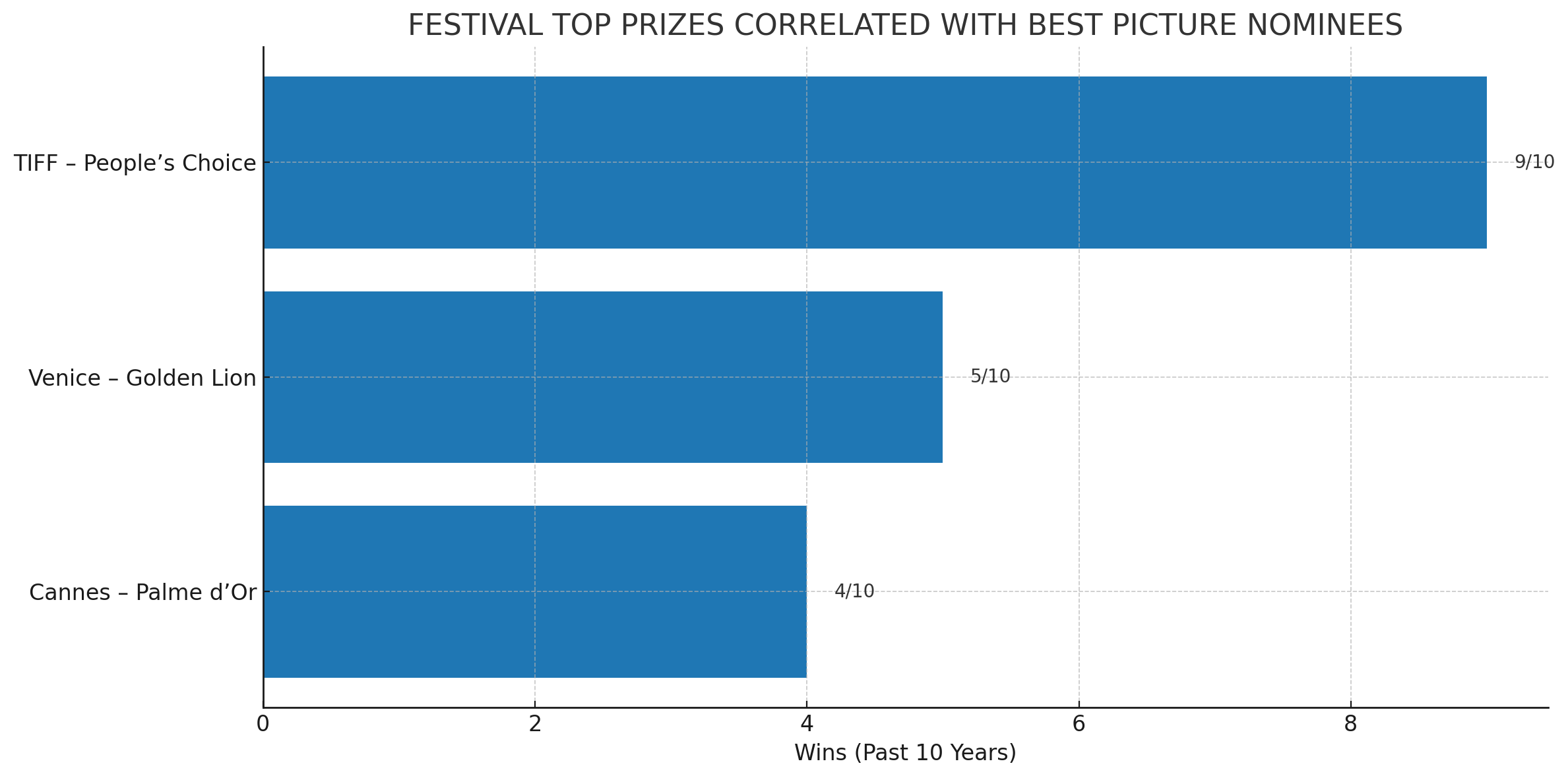
In the past decade, Best Picture Nominees have also been closely correlated with Festival top prize winners:
TIFF - People’s Choice Award - 9 out of 10 years
Venice - Golden Lion - 5 out of 10 years
Cannes - Palme d’Or - 4 out of 10 years
So, although Venice premieres the most Best Picture nominee films, TIFF’s People’s Choice Award appears to be the most accurate predictor.
Voted for by the attendees of the TIFF festival, this award captures the preference of a North American audience. As almost 2/3rds of TIFF’s Industry attendees are US or Canada-based, it’s likely that 90+% of festival goers hail from North America. This aligns with the Academy Voters, which skew heavily US.
Although other festivals have audience awards, Cannes and Venice’s jury-selected accolades are more likely to miss.
There is a buzz around this year’s festival award winners: Jafar Panahi’s It Was Just an Accident, which was awarded the Palme d’Or, and Chloe Zhao’s breathtaking fifth feature, Hamnet, which brought home TIFF’s good omen - the People’s Choice Award.
Although it won the Golden Lion at Venice, Jim Jarmusch’s Father Mother Sister Brother (picked up by Mubi) has not been seeing the same attention, odd considering it was an excellent piece of cinema with favorable reviews. Out of Jarmusch’s 13 previous films, not one has been nominated for an Oscar, despite them being highly lauded at prestigious festivals.
GENRE
Not all genres were created equal - in the Oscars' eyes, anyway.
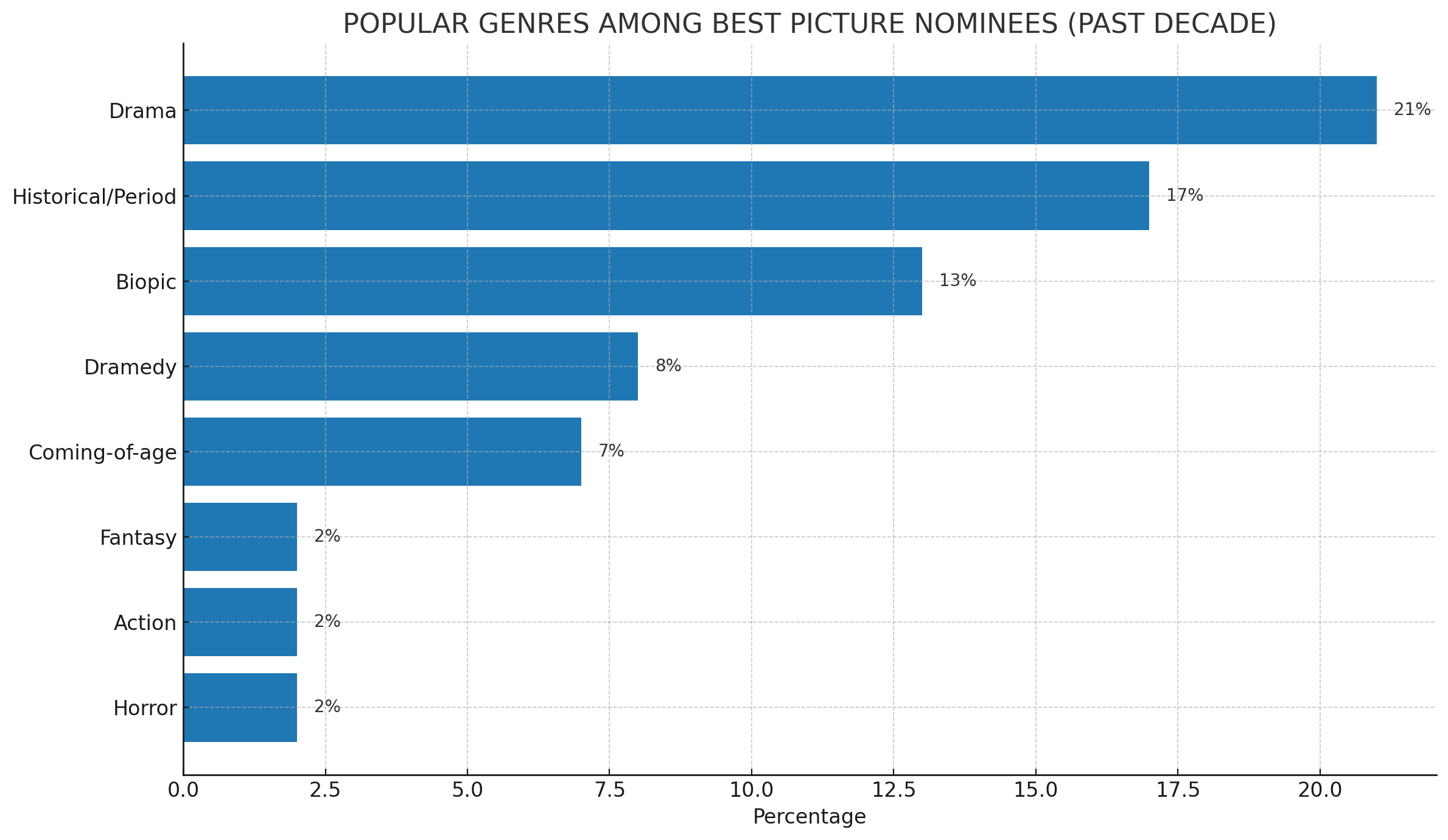
The more popular genres* for nominees for the last 10 years:
Drama - 21%
Historical/period - 17%
Biopic - 13%
Dramedy - 8%
Coming-of-age - 7%
*For each film, we picked a dominant genre - for example, Lady Bird is classed as coming-of-age, although it could also be termed a drama. And The Brutalist is a historical/period. And Elvis is a biopic.
Interestingly, these percentages have stayed iron-clad over the past decade. No notable changes in the last three years, or pre-/and post-COVID. You can only see a noticeable shift if you look at the last decade (2016-2025) vs the one prior (2006-2015). You see a drop in romance, war, and crime. And a small uptick by a few percent in horror, superhero, fantasy, and action. But the highest increase is in straight drama.
Drama and its comedic sister Dramedy make up an unsurprisingly high percentage of votes due to their wide range/appeal.
This is good news for potential nominees, like biopic Springsteen: Deliver Me From Nowhere, which had the added benefit of premiering at Telluride, and is probably why Focus Features is pushing their late entry Song Sung Blue (premiering at AFI). The period piece The Testament of Ann Lee, directed by Mona Fastvold, who co-wrote last year’s BP nominee and Best Screenplay winner, The Brutalist, also seems a worthy contender.
But Hamnet, which won TIFF, is being considered closely as not just a nominee but a probable Best Picture winner.
Now for the less-favourable genres:
Fantasy - 2%
Action - 2%
Horror - 2%
The 2% club, or “genre” films. Though these films are not generally shown much love in the Best Picture category, there are always outliers—last year, pumped-up body horror The Substance joined the nominees, becoming only one of three horror films in the last 20 years.
The Substance wasn’t an outlier in terms of horror’s popularity outside of the awards circuits. Horror has been steadily growing in the mainstream, and distributors have taken notice. Warner Bros. is mounting a sizable campaign for Sinners and Weapons, their two original horror juggernauts. It seems like Mubi’s The Substance could pave the way for distributors to consider their horror films as serious Oscar contenders in the future.
US AND INTERNATIONAL
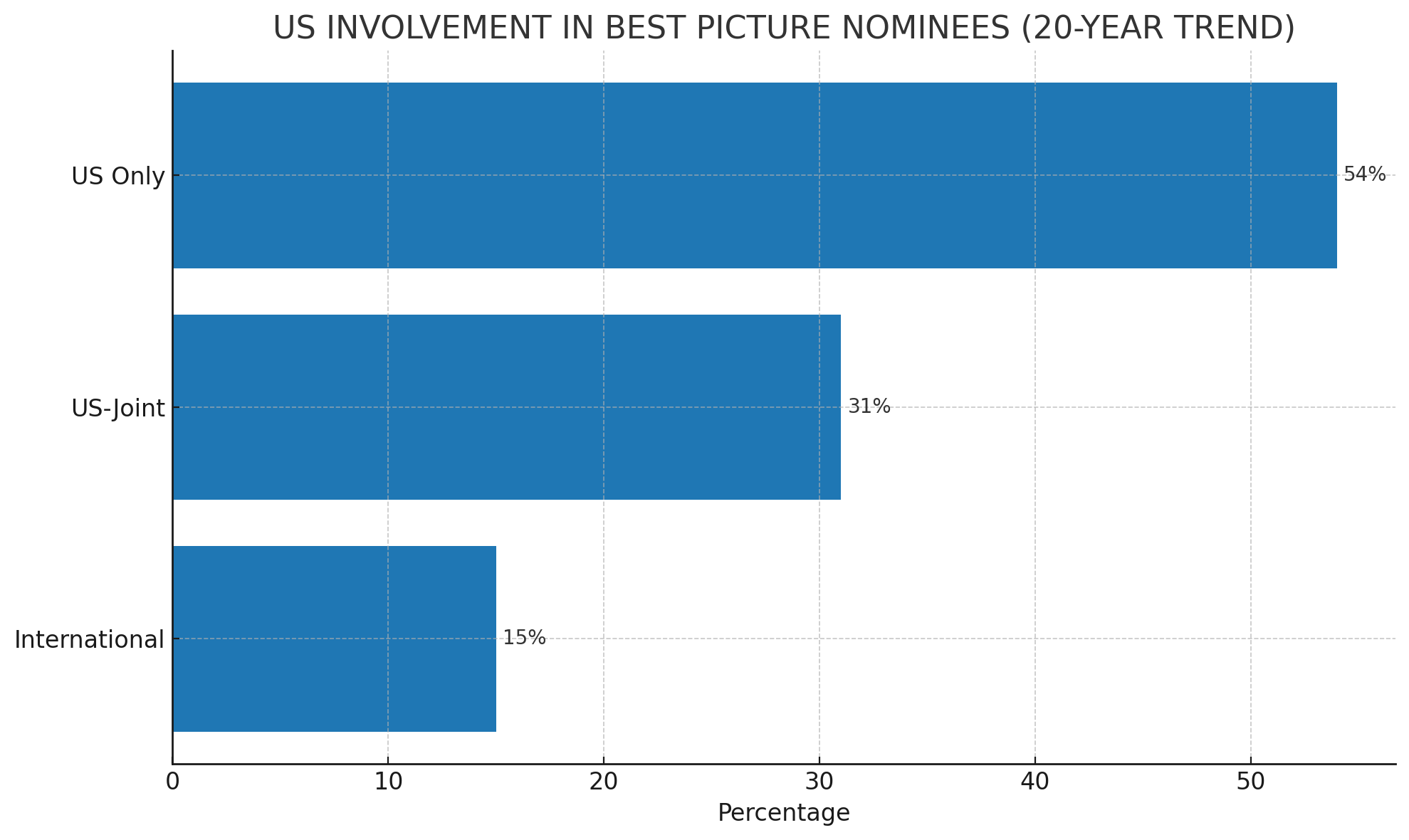
Unsurprisingly for a US competition, the Oscars generally recognize American-backed films.
This has always been a staple, and the percentage of movies that have US involvement hasn’t changed much over the last 20 years: 54% solely US productions and 31% US-Joint (meaning a joint production between the US and one or more other countries).
Although this means non-American films are less likely than their US counterparts to be nominated for Best Picture, there’s still plenty of space for international entries. Over the last few years, this includes the French-Brazilian film I’m Still Here, the German All Quiet on the Western Front, and the Japanese Drive My Car. Not to mention the winner of the 2020 Best Picture was the South Korean film Parasite.
As the Academy DNA changes with new members, we could start to see a shift in this allocation. Of the individuals invited to join AMPAS in 2025, 55% were international. Could this, in turn, shake up the festival game, with future nominees coming off premieres at Hong Kong, Edinburgh, or Karlovy Vary?
BOX OFFICE GIANTS*
*Box office giant = films making over $300M WW.
When the Best Picture category expanded in 2009, it was to encompass a range of cinema - blockbuster and festival-darlings alike. In the years since, 19% of the Best Picture nominees have been box office giants (33 films).
However, it does need critical acclaim and a suitable genre - for example, there has only ever been one superhero movie nominated, which was Ryan Coogler’s Black Panther in 2018 (making $1.3 billion worldwide). This means it is unlikely for this year’s Superman, however well-liked and well-performing, to make the cut.
Other less favorable genres for the money-makers include animations, minus, sequels like the still not nominated Jurassic World series, and children/YA films like The Hunger Games. Although Top Gun: Maverick (which made $1.5bn) bucked the trend with its nomination in 2018 as an action film and a sequel. As there are only 10 slots, certain films that meet all these criteria can still miss out, such as Greta Gerwig’s Barbie in 2024.
I mentioned before that horror is a rarity in the big ten, but Sinners (with its box office standing at $366M) is a hugely likely contender. At the time of writing, it is currently the 14th highest-grossing film of the year, which was a surprise to many - it is this exact surprise that opened such a dialogue around the film, along with its rave reviews and unique premise. Could it be the second-highest-grossing horror to ever receive a nomination? (Beaten by Sixth Sense, the original release raking in $672m.)
The last rule of thumb for blockbusters is this: as was the case with Dune, The Lord of the Rings, and The Godfather, it is expected for a film’s later installments (not sequels but continuous parts) to be nominated if its first one was. Good news for Wicked: For Good.
Epilogue
Although it makes sense that a historical drama with US involvement that premiered at Telluride and won the People’s Choice Award at TIFF (Hamnet) would be the perfect Best Picture nominee, we can see there are always outliers that manage to break our perceptions of what the Oscars are looking for. And with an ever-changing Academy voters, it will be interesting to see how a Best Picture film looks in the near future.
Today’s article on the academy awards was so insightful in explaining the powers structure of the different film festivals.
I always was in the dark of how each stood in true impact .
Truly outstanding article.