

The Matrix and a Fake Ostrich

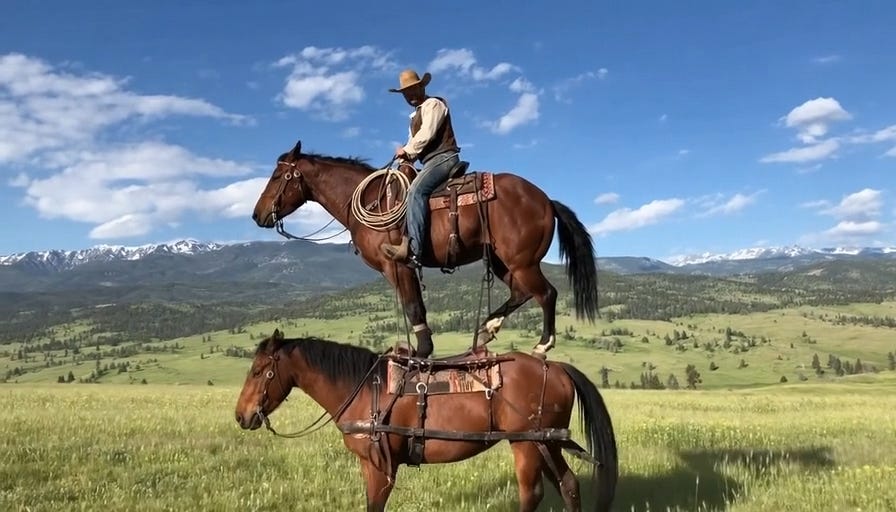
When the first generation of AI video clips came online, they were creepy.
A bizarre beer ad. An uncanny Google avatar. A nightmarish Will Smith eating pasta.
They were easy to distinguish from reality, and that made it easy for us to compartmentalize them as having an inconsequential effect on human creativity.
Things have changed.
ChatGPT’s parent company, OpenAI, has just launched the second generation of its text-to-video AI platform, Sora 2.0.
This platform takes written prompts and converts them to photorealistic video, now with matching audio. The results look very real, which is terrifying because it reduces the time and cost needed to make a stunning piece of footage to zero.
Here are two prompts given to Sora 2.0 and their results:
A man rides a horse that is on another horse [pictured above].
An ostrich steals dads hat and dad chases after it.
Each one of these videos is remarkable and disruptive for its own reasons. The first video, with the man on the two horses, seems like an image pulled straight out of an Old Spice commercial.
Already, we’re seeing brands lean into AI videos. Ten months ago, Coke (video) received backlash for its AI ad. But more recently, an AI ad that premiered during the NBA Finals for the betting platform Kalshi (video) was received more favorably. So it seems that commercial filmmaking is particularly vulnerable to AI disruption because of its reliance on short clips and flashy B-roll (all specialties of Sora 2.0).
The second video of the father shows off Sora 2.0’s ability to “directly inject elements of the real world” into videos. This means that filmmakers involved in short-form storytelling can opt out of having a DP, production designer, or a costume designer. One way to do this would be for them to just upload a video of a friend and type in a prompt. And then poof, now that friend is playing a trumpet in a zebra stampede (Sora 2.0 video).
And now you don’t even need to have a real person in your video. AI actors look realistic enough to be considered a major threat to Hollywood talent. Just look at the recent uproar about Tilly Norwood, an AI-generated actress (video explainer). Talent guilds (SAG-AFTRA) and talent agencies (WME, Gersh), as well as a slew of real actors have come out against AI performers.
This brings us to how AI’s threat to Hollywood is misunderstood.
OpenAI’s demo video for Sora 2.0 claims that it is:
“Marking a giant leap forward in realism.”
This is absolutely true.
For instance, Tilly’s face does look “real.” And it looks almost recognizable. But that is because it resembles what The New Yorker’s Jia Tolentino describes in her essay Instagram Face:
“Social media, FaceTune, and plastic surgery created a single, cyborgian look…it’s a young face, of course, with poreless skin and plump, high cheekbones.”
Every AI video we see is the average of all the videos it has ever been trained on. That’s why the horses that are balanced in the first Sora 2.0 example video look identical to what you get when you Google “horse.”
I’m not even joking, check here. And compare to the video.
So the video it has generated is the most popular horse. The field, the most average-looking field, the cowboy, the most stereotypical cowboy.
AI-generated footage, though, is worse than just being average. Because there was never a real horse or a cowboy in front of a camera to begin with. There was no film shoot. OpenAI is generating videos that look like copies that don’t have an original.
And that is pushing it to make imagery that is hyperreal. A fake reality that looks better than reality.
That’s different from traditional media. Even when a camera is not present, in CGI or animation, every detail is designed by artists. The characters, the environments, the motion. There’s always an original vision behind what you see. Sora 2.0 takes a prompt and fills in the rest with averages. It doesn’t build from an artist’s design palette.
And because of that, the “better-than-reality” sheen it creates is far more seductive. Like Tilly’s face or Sora 2.0’s idyllic sky. The platform generates the most idealized version of whatever you type in as your video prompt.
What we risk here is having a culture that is flushed with AI videos that present a world that on the surface looks much better than the reality we actually experience in day to day life.
The issue is that we live in the real world, with real people. And when our media diet shifts to AI-generated videos, we’re going to be living in a culture that is no longer based on human creation, but that of machines.
For More:
Did The Matrix get it right? Morpheus says, “At some point in the early 21st century, all mankind was united in celebration. We marveled at our own magnificence as we gave birth to AI.” Clip.
AI video two years ago: Will Smith eats Spaghetti. So weird.
And now: Sora 2.0 full trailer.
Finally:
The scariest part of all this? Sora 2.0 puts the burden on the copyright holders to opt out of their IP being used (Wall Street Journal article). The MPA has already come out against this.