


David Larkin was the founder of GoWatchIt and Head of Business at Letterboxd. He consults with film and tech companies, and is an Executive Advisor at Harpoon Media.
THE POST-VIEWING WINDOW: The New Economics of Experience
A FEW WEEKS AGO…
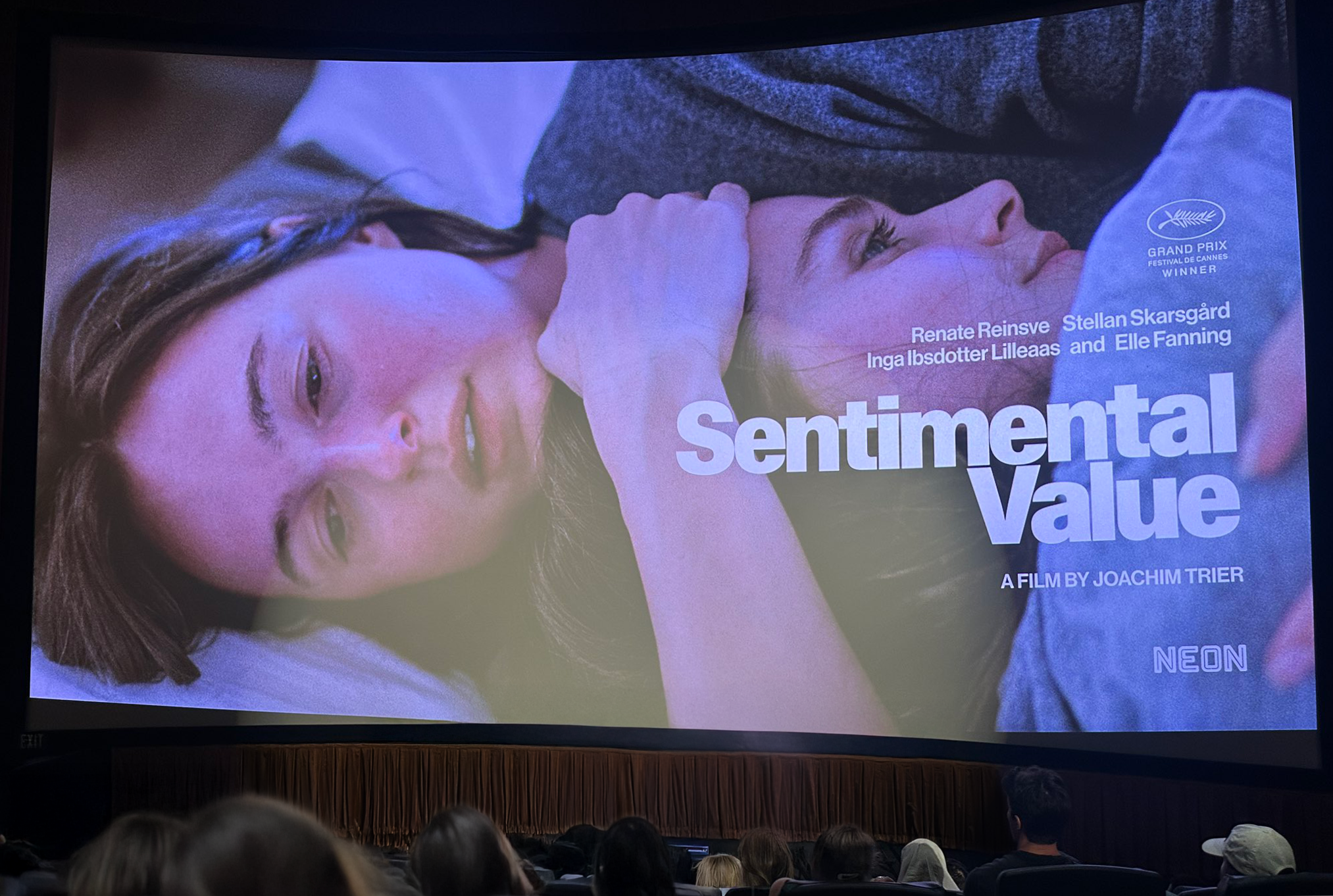
A few weeks ago, my wife and I walked out of a movie we loved (Sentimental Value) feeling warm and glowing. We went to a bar to talk about it; within minutes, we had bought tickets for another movie the same night. Not because we planned to. Because we were in the perfect emotional state to do it.
That moment — the post-viewing window — is what TikTok and Netflix leverage to create habit. And Hollywood essentially ignores it.
The movie industry is always asking the eternal question:
How do we get people back into theaters?
The more important question no one is asking is:
Why do we hustle them out at the exact moment they’re most suggestible?
The five minutes after a film ends — the emotional peak, the cognitive low-friction zone — is the most underdeveloped opportunity in the entire entertainment ecosystem. TikTok captures it. Netflix captures it. The movie industry treats it as an operational inconvenience.
This essay lays out the cognitive science behind that mistake, the industry incentives that keep it in place, and a redesign that could help rebuild the ritual of moviegoing from the inside out.
I. The Sharing of the Experience Must Be Structural
Experiences used to end when the moment ended. A concert finished, the lights rose, and the crowd drifted out. A movie faded to black, and you were quickly back in the real world before you even reached the parking lot. The experience was self-contained, finite, and bounded by time.
But in the social-media age, at least for a huge slice of the younger cohort, an experience is no longer complete until it is shared. The “after” has fused with the “during.” Participation and broadcasting are now the same behavioral event.
The postscript is now the point.
Travel used to be for personal experience. Now it is about achieving the right social signal on your Instagram feed.
The first time I saw Venmo, I wondered: Who would ever want their random payments exposed to the world?
And yet people loved it. Payments became messages. Microtransactions became micro-performances. A UX decision fused finance with identity.
That is when I learned that the sharing of the experience must be built into the experience itself — structurally.
In downtown New York, at almost any time of day, you will find a line outside Bubby’s Restaurant. They aren’t just there to try the waffle — they are there to photograph themselves eating the waffle.
People aren’t seeking just experiences.
They are seeking shareable identity generated by experience.
Jerry Seinfeld, in an interview with GQ in April 2024 while promoting Unfrosted, put it plainly:
“Film doesn’t occupy the pinnacle in the social, cultural hierarchy that it did for most of our lives. When a movie came out, if it was good, we all went to see it. We all discussed it. We quoted lines and scenes we liked. Now we’re walking through a fire hose of water, just trying to see.”
When asked what replaced it, he added:
“Disorientation replaced the movie business.”
Movies once supplied the shared language people talked about the next day. That conversational energy — the quoting, the riffing, the remixing — now lives inside platforms that are structurally optimized for sharing: TikTok, Instagram, YouTube.
The social practice that once made movies central hasn’t disappeared; it has migrated.
Hollywood is still a spectator to this shift.
II. Two Economies of Watching Movies
Hollywood still thinks it sells movies. What it actually sells are two different economic products operating across two different cognitive systems in the same human mind.
One is perishable.
One is durable.
And the industry has historically optimized for only one.
Psychologists Daniel Kahneman and others describe these two modes of mind as:
System 1 — fast, intuitive, emotional, automatic: I just find myself doing this.
System 2 — slow, deliberate, effortful, analytical: I am consciously deciding.
The culture has decisively moved toward System 1, and the companies that lean into that have become dominant.
Theatrical moviegoing begins in System 2 and ends in System 1 — and then the experience comes to a full stop.
Why “Perishable” and “Durable”?
The theatrical economy is perishable because its value decays almost instantly. A movie is most valuable to theaters on opening weekend; its value collapses within days. The experience is tightly bound to time, logistics, coordination, and cultural momentum.
Perishability comes from:
fixed showtimes
limited seat inventory
fast-expiring cultural relevance
marketing peaks that collapse in days
the planning burden required to attend
It is like fresh produce: if you don’t consume it now, the value evaporates.
Streaming is durable. Its value doesn’t decay. A movie on Netflix is as accessible next week as it is tonight. No planning. No scheduling. No coordination.
Durability comes from:
infinite inventory
zero scheduling friction
on-demand access
ambient, low-effort discovery
context-free consumption
Streaming lives in the emotional present.
Theatrical lives in the logistical present.
Hollywood assumes durability simply “defaults” out of the theatrical spike: open big, market loudly, and the long tail will take care of itself.
But durability is not automatic. It is engineered.
A perfect example: Barbenheimer.
Neither studio planned the meme. Neither coordinated the pairing. But the user-generated ritual created massive, durable value: extended runs, expanded audiences, streaming demand, and cultural identity loops neither brand could have manufactured alone.
Hollywood didn’t build Barbenheimer. Audiences did.
More recently, for the Minecraft Movie, the “Chicken Jockey” trend began as organic fan reaction to the movie’s trailers, but it transformed into high-energy participation when TikTokers started ironically cheering for Jack Black’s dramatic lines (see above). Warner Bros. strategically leaned into this ridicule by providing influencers with tools and meme-ready clips, essentially turning the mockery into a deliberate marketing engine. This resulted in massive box office success as teens flooded theaters to film themselves participating during the film.
Durable value emerges from behavior, not from spend.
III. The Post-Viewing Window: Hollywood’s Blind Spot
The moment immediately after a movie ends is the most cognitively and emotionally primed moment in the entire entertainment economy — and Hollywood does nothing with it.
A viewer who walked in in System 2 is now in full System 1 flow when the credits roll:
heightened emotion (if the movie induces a strong positive or negative feeling)
open receptivity
limbic arousal
impulse readiness
desire for expression
low cognitive friction
This is the rarest state in media: maximum emotional charge plus minimum resistance.
And the industry tells the audience to leave.
No ritual.
No continuation.
No memory-binding.
No habit formation.
Meanwhile, Netflix and TikTok never waste this window — because the viewer is already home, already on the device, already one tap away from sharing or consuming the next emotional hit.
 Tiktok failed to load.
Enable 3rd party cookies or use another browser
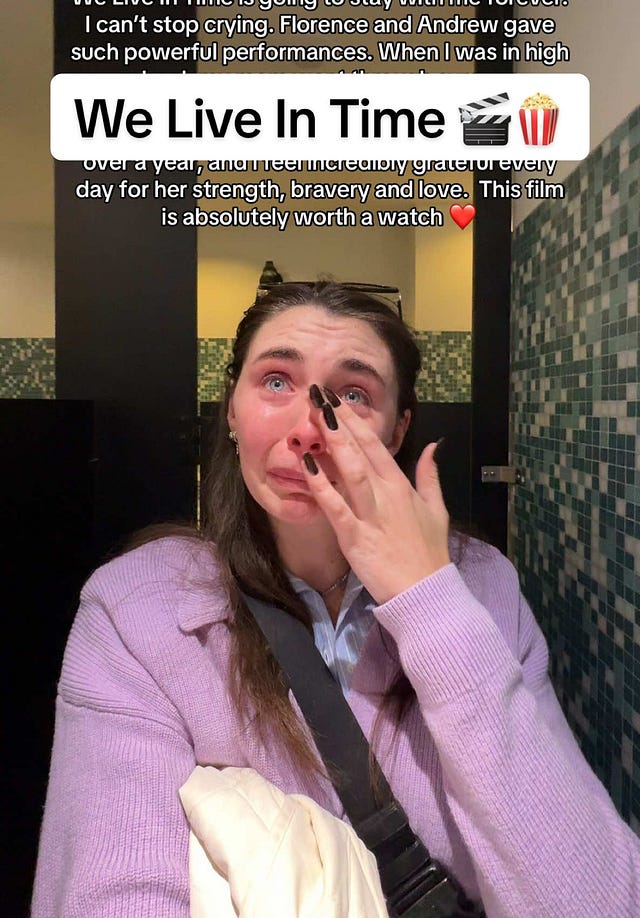
One recent campaign that leaned into the power of these moments was A24’s Instagram marketing campaign for We Live in Time (2024). Instead of standard trailers, they shared footage of young women crying as they exited the theater or sat in their seats as the credits rolled. By capturing and broadcasting that immediate, post-movie viewing emotion, A24 successfully turned moviegoers’ authentic emotional responses into a powerful public social signal. Most romantic dramas drop off quickly, but We Live in Time showed unusual staying power, remaining near the top of the box office charts for multiple weeks as viral reaction videos sustained interest well beyond the initial marketing campaign.
When my wife and I bought those second tickets after Sentimental Value, we weren’t shopping.
We were extending a feeling.
We used System 2 only long enough to secure another System 1 experience.
Imagine if the theater had simply acknowledged that state, and a QR code came up on screen, or we got a message on our phones at the end of our film that said:
Another film begins in 12 minutes. Want 30% off? Giving us a link to click on.
That’s not an upsell.
That’s emotional physics.
The industry usually discards this moment.
IV. The Structural Flaw: Optimized for Exit, Not Continuation
Movie theaters are optimized for churn, not behavior formation.
From the abrupt rise of the lights, to cleaners entering, to the push toward the parking lot, every detail is designed to move bodies out — not bring them back.
Two failures follow:
Zero investment in habit
Each visit is treated as a one-off transaction, not the beginning of a loop.Wasted System 1 gold
The most suggestible five minutes evaporate. Audiences exit and instinctively open their phones — straight into TikTok’s world.
V. The Industry Incentive Problem
Each film is run as its own isolated P&L.
No one is rewarded for building theatrical behavior itself.
Marketing teams care about opening weekend. Exhibitors care about turnover. Studios move on to the next title.
This is why the Nicole Kidman AMC spot feels quaint.
Emotional monologues don’t create habits.
TikTok doesn’t use monologues.
It uses loops.
VI. The Wrong Fix: Treating Theaters Like Empty Real Estate
Facing declining attendance, theater chains are now considering turning cinemas into “entertainment hubs” — adding bowling, arcades, dining, and even pickleball courts.
The logic is clear: theaters are seen as underutilized real estate that needs more diverse revenue streams apart from movies.
But this reframes cinemas as generic leisure containers rather than what they actually are: the emotional engine of movies.
Ironically, theaters already know how to shape behavior when they want to. No part of the movie business is more ruthlessly optimized than concessions. The lighting, the smell of popcorn, the queue design, the on-screen promos — all of it is engineered to capture attention, trigger impulse, and convert emotion into action.
The industry has spent decades perfecting this system, and it works. Movie theaters currently derive 75% to 80% of their net profit from concessions, despite food and beverage only accounting for about one-third of total revenue. While ticket sales are split with the studios, theaters maintain over 85% profit margins on snacks, with average spending per patron reaching record highs of $7.74 at AMC and $8.34 at Cinemark.
What’s missing is that same intentionality applied after the film, where there could be just as much commercial potential.
The five minutes following the credits are not just a cultural or emotional blind spot — they are a commercial one. Audiences leave at their most open, energized, and socially primed, yet theaters offer nothing to buy, do, or commit to that extends the experience itself.
Pickleball doesn’t solve this problem. It diverts energy away from movies instead of deepening it.
The opportunity is not to add more attractions, but to design the post-movie moment so that theaters remain the natural place where cinematic energy converts into both habit and revenue.
A well-designed post-viewing window can do both at once: reinforce moviegoing as a ritual and unlock new commercial pathways that are native to film rather than adjacent to it.
VII. Colonizing the Post-Viewing Window: A Studio–Exhibitor Partnership
To reclaim the most valuable psychological window in entertainment, theaters and studios must build a shared, integrated post-viewing pathway. This is not a marketing initiative or a real-estate play. It is behavioral architecture.
The moment the lights come up, the audience reaches for their phones. Currently, they open Instagram or TikTok. Theaters need to provide the “landing page” for that specific moment — a digital container for the emotion they just manufactured.
This means investing in concrete products, not just studies.
The Debrief
A QR code on screen that unlocks a short, exclusive conversation with the director or cast, geo-fenced to the theater. You don’t watch it later; you watch it now, while the feeling is fresh. It validates the emotion you just felt.
A. Behavioral Reinforcement Architecture
The lobby should not be a throughput zone. It should be a Capture Surface — the bridge between emotional peak and cultural action.
That requires shifting investment toward:
identity
technology
community
shareable ritual
The shareable moment must be tied to the active experience, not merely the physical location.
The Decompression Zone
Don’t dump people into the parking lot.
Funnel them instead into a retail / social buffer — the same way museums deliberately route visitors through the gift shop. Not to extract money, but to extend meaning.
This is where emotion decelerates, where conversation begins, and where memory hardens into identity.
The exit should feel like a continuation, not a rupture.
Exclusive Micro-Content
Using local Wi-Fi, theaters can unlock exclusive content available only in the theater immediately after the credits:
AR filters
GIFs
short clips
sound bites
visual motifs from the film
These assets are available only in the post-viewing window.
They bind the emotional high to an act of expression.
The Immersive Shareable Kiosk
Deploy highly visible kiosks just outside the auditorium.
Not a photo booth — a content forge.
Using green-screen VFX and rapid compositing, viewers are dropped into a scene, environment, or emotional moment from the film and leave with a short, native, share-ready clip. Built for TikTok velocity, not souvenir novelty.
Behavioral Prompts
Subtle cues — architectural, visual, and digital — guide the audience into a simple ritual:
“Record your reaction.”
“Unlock your badge.”
“Post your moment.”
Humans love ritual even more than convenience.
B. Monetization as Ritual Reward
To convert behavior into habit, rewards must be immediate, identity-driven, and socially portable.
Recently for the Minecraft Movie, themed popcorn buckets were planned months in advance as part of the film’s theatrical merchandising strategy. While Warner Bros. and theater chains expected strong fan interest, the buckets became an integral part of a gusher of viral behavior, driving theater attendance and helping keep the film in the broader conversation beyond its initial marketing push.
The Minecraft popcorn buckets were sold only through participating theater chains (AMC, Regal, Cinemark, etc.) during the film’s theatrical run. They were not broadly available through retail at launch, which made attendance the gatekeeper to ownership.
Identity Merchandise
Studios and theater chains could team up to offer special edition items redeemable only at theaters, perhaps offered after the credits roll:
K-pop concert film — an official light-stick authentication charm or wristband that certifies attendance and folds the theater into the fandom ritual.
Dune: Part Two — a small Fremen water discipline charm that functions as a symbolic trophy of initiation rather than a souvenir.
These are not souvenirs.
They are trophies of participation.
The goal isn’t incremental revenue.
It’s habit formation.
VIII. Designing the Next Habit Loop of Moviegoing
This is not a marketing challenge.
It is behavioral design.
Habit requires:
trigger
action
reward
identity
community
repetition
Hollywood currently controls only the action.
The post-viewing window controls the reward.
If Hollywood doesn’t reclaim the post-viewing window, other platforms will continue to define cinema’s afterlife.
No single player can fix this alone. Studios control the story. Exhibitors control the space. The post-viewing window sits between them — and capturing it requires a renewed partnership built around behavior, not just box office splits. Not marketing coordination. Not branding. Shared ownership of the moment where emotion turns into habit.
Movies didn’t lose their place in culture because people stopped loving them.
They lost it because the conversation moved somewhere else.
Cinema once dominated not just because of what happened on screen, but because of what happened afterward — the quoting, the arguing, the collective meaning-making.
That energy never disappeared. It was simply captured by platforms designed to absorb it.
The post-viewing window is where movie culture used to live.
If Hollywood wants movies to matter again, it won’t be by extending runtimes or inflating spectacle. It will be by reclaiming the moment when audiences are most emotionally alive — and designing the system around it.
Fantastic article, David is always ahead of the game.
This is the most fascinating thing I've read all year. It feels like you've locked onto the essence of something Hollywood should really be thinking about, especially now, as we race into what is predicted to be the most dramatic transformational moment in industrial history. I've already started mourning the death of our beloved Hollywood. For the longest time, I thought it was the industry that changed, but this makes me think. Maybe it's me. Maybe it's the audience that's changing.